

Can I Draw A Monument And Sell It Or Do I Need Permissiin
Have y'all ever wondered what your rights are as an artist? At that place's no clear-cut textbook to consult—simply we're here to help. Katarina Feder, a vice president at Artists Rights Society , is answering questions of all sorts about what kind of control artists have—and don't have—over their work.
Practice you have a query of your own? Email [email protected] and it may get answered in an upcoming commodity.
I'thousand an artist and I'm thinking of making an NFT. Are NFTs governed by copyright? Likewise, what's an NFT?
Reader, y'all were the 17th email about NFTs in my inbox on the day you lot sent this, then yous know what that means: You lot win two tickets to a Rihanna concert at the Barclays Heart! And, of course, an answer in this month's column.
To my astonishment, NFTs (likewise known equally non-fungible tokens) have captured the imagination of people effectually the globe. NFTs can be fabricated from practically anything digital—songs, Tweets, whatsoever. Using blockchain applied science, NFTs render these infinitely reproducible items—like the song y'all listen to on Spotify ad infinitum—unique.
In other words, while anyone can run into and easily download the video clips that found Grimes' digital artwork (of which she sold a casual $5.8 million worth through Maccarone ), they would take to purchase the individual, impossible-to-pirate, limited-edition NFT version if they wanted the distinction of owning the original, collectable version.
James Tarmy at Bloomberg wisely pointed out that this is essentially the aforementioned way the market for photography already functions, with an artist-fabricated print fetching a price that is exponentially higher than a poster of the same paradigm would. Past way of comparison, I'll remind y'all that a frenzy for tulips in the Dutch Republic in the 17th century at ane point made the flowers more valuable than gilt . The old aphorism is true: Scarcity really does create value.
I've been approached past many people interested in collaborating on NFTs because my business firm, Artist Rights Order, is a clearinghouse for artist copyrights. Nosotros represent over 122,000 artists and estates worldwide, so if you want to reproduce an artwork for a catalogue or make a t-shirt for your museum gift shop, the request often flows through us. And the dynamic is the aforementioned for an NFT equally it is for a t-shirt: the copyright for an artwork rests with its creator (unless the creator has been dead for 70 years).
If y'all're an artist, that ways you tin can make an NFT of your own piece of work free and clear. If you want to make an NFT of an artwork that's not your own, yous demand to get to the source for permission.
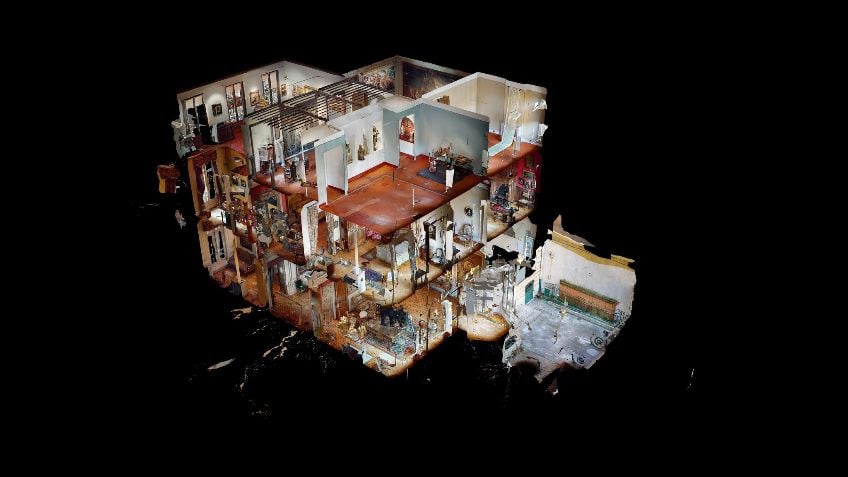
Dollhouse at Musée Grobet-Labadié Virtual Tour © Courtesy of Manifesta 13
Our museum is however closed and as nosotros consider the long-term effects the pandemic will have on museum visitation, nosotros would like to add more virtual components to our exhibitions, including 3D walkthroughs and extended online tours. How should we approach licensing in this situation? Should we seek permissions for reproductions in the same way we would for a print pamphlet?
Showtime, let me give thanks you for your caution. We're keenly aware that our partners in the museum earth are in demand of admission funds, and it's great that you're encouraging visitors to return at the pace that'southward right for them, and for everyone else.
Museums have gotten increasingly creative in recreating their shows for viewers at home—only you're right to wonder nearly the right to reproduce content because, as readers of this cavalcade know well, buying of an artwork rests with its creator rather than its owner. Anything you lot're planning needs to be approved by the artist, their manor, or a collective rights organization like ARS.
I recommend thinking about virtual exhibitions in the same fashion you would call up about reproducing works for print: you need to go to the same people for authorization.
The big caveat here is that copyright endures the life of the artist, plus lxx years post mortem. So if you're a museum with many older works like the Metropolitan Museum of Art , y'all would already be in the clear. Best of luck with this and with your reopening.
Instagram photograph Illustration by Omar Marques/SOPA Images/LightRocket via Getty Images.
How should you deal with people who share your work on Instagram but don't tag or hashtag you (specifically, influencers who make coin from the site)?
I'thou distressing to hear you lot are having this trouble. Instagram has opened many doors for many artists—just of grade, nothing comes without a toll. We go this query from artists fourth dimension and fourth dimension over again.
Let's offset off by discussing your rights. 6 photographers are currently suing Buzzfeed over its use of their images of this summer'south Black Lives Matter protests. But Buzzfeed'south actions may, unfortunately, be acceptable thanks to what one judge chosen " a non-exclusive, fully paid and royalty-costless, transferable, sub-licensable, worldwide license " that is implicitly granted past posting to Instagram.
That situation sounds a scrap different from your trouble, however. It seems that college-profile users are either passing off your own Instagram photos every bit their own or photographing your work without giving you credit.
The latter concerns your "display rights" as a copyright holder. Information technology's a surprisingly tricky issue because there isn't a ton of instance police established here. At that place are a number of questions to consider: For starters, has the person photographed your work in a fashion that might exist considered transformative due to their ain creative input? To what extent is the photo about your work, and to what extent is it about the influencer? (If the influencer is taking up more than than fifty percent of the image by, say, posing in front of your painting, the photograph may be considered more about them than nearly your work.) Is the epitome likely to hurt your market? (An statement could be made that by fifty-fifty unwittingly sharing your work, the influencer is boosting your profile.)
You can come across how complicated this gets. For more, allow me to straight you lot to this lengthy commodity by Herrick , a law firm that often works with the art world, about photographing works for catalogues. Information technology'southward a good, if flawed, analogy.
Now for the former scenario: If the person in question is taking your Instagram posts and claiming them as their own, we're in more of a FuckJerry situation . Even there, nevertheless, the law is unclear because it'south hard to prove the extent to which the thief benefitted from your specific piece of content. A plaintiff who tried to prove Jerry had stolen the image for a particular sponsored mail service dropped his case in 2019 considering he was, it turned out, " near certainly not the original creator " himself.
Regardless of the specifics, I would endeavour reaching out to the user in question. Mostly, this is a elementary misunderstanding. And in my experience, Instagram is rarely worth a lawsuit, fifty-fifty if you're Kanye West .
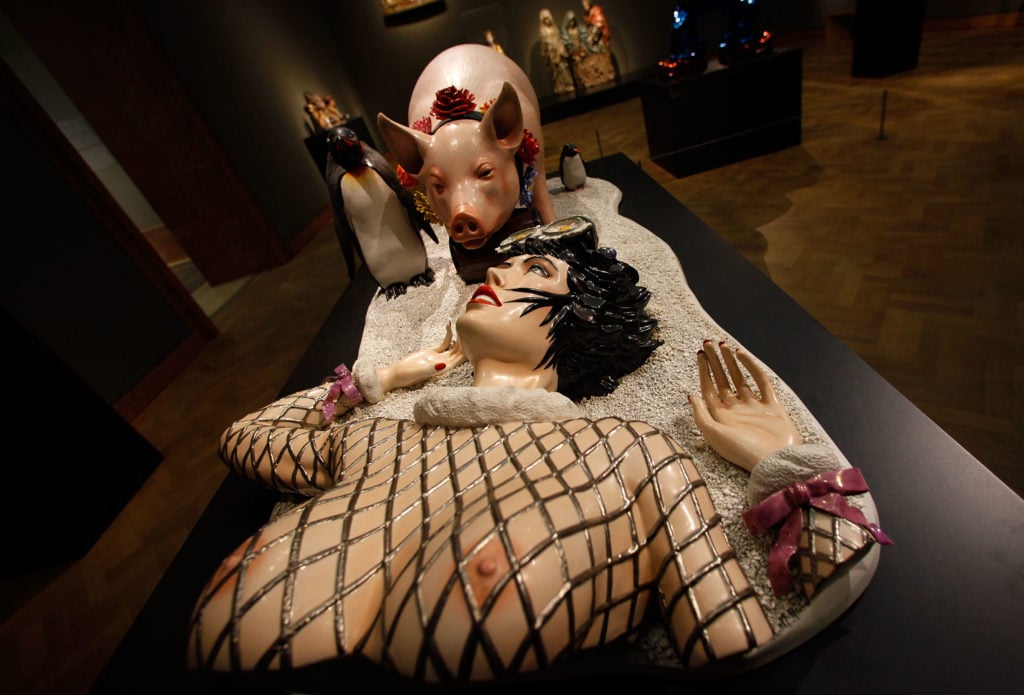
Jeff Koons'south sculpture Fait D'Hiver (1988). Photograph by Ralph Orlowski/Getty Images.
Explicate Jeff Koons to me. Sometimes he wins lawsuits, sometimes he doesn't. He just lost one in France but that hardly helps to explicate things. Explain Jeff Koons to me, please, somebody.
First, I'd similar to put forth a personal theory that, from a artistic standpoint, Jeff Koons welcomes beingness sued. Don't purchase it? Koons one time "created" framed posters that take been made by Nike, a company well known for its rigorous lawsuits against infringements . Koons went so far equally to telephone call the works "originals," even though they were unmodified. The guy clearly gets off on being a copyright provocateur.
So what makes a successful Koons lawsuit? Your gauge is as good as mine. The French lawsuit you cite in your question centers on Koons'south Fait d'hiver. The epitome is copied from a mag advertizing, albeit a very French one , in which a pig sniffs a gorgeous woman in the snow. Sounds familiar? Consider Blanch v. Koons , which we discussed last year . In that case, Koons took a copyrighted paradigm of a woman'due south leg and anxiety that he found in an American effect of Allure .
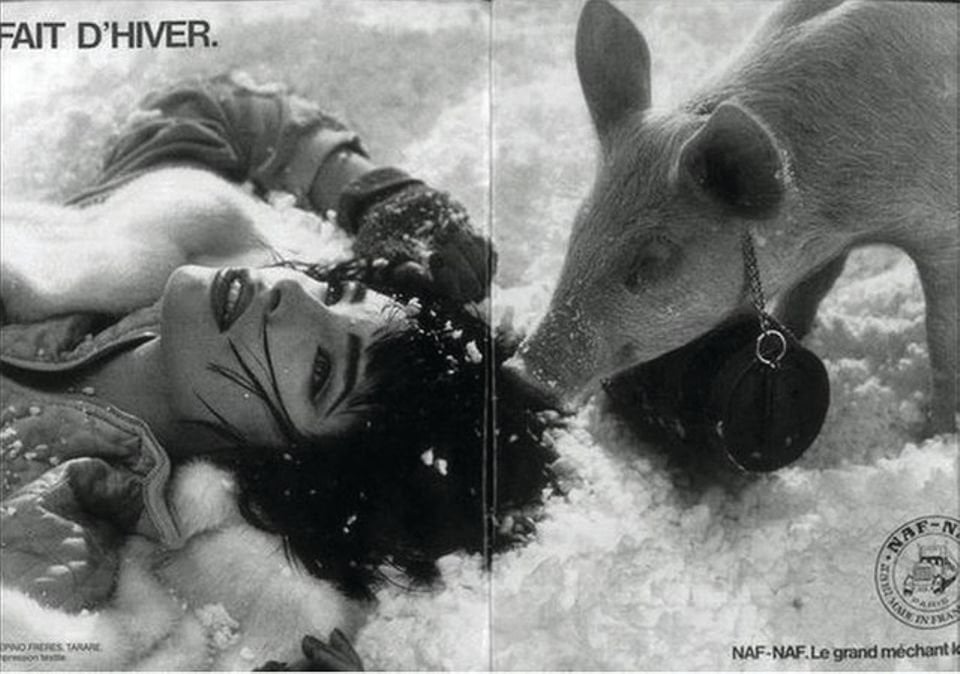
Elisabeth Bonamy, Franck Davidovici, and William Klein's "Fait d'Hiver" advert entrada for Naf Naf (1985).
The Blanch case institute Koons guilt-complimentary of copyright infringement, with the American court arguing that the original prototype was, curiously, too "banal" for protection. This latest suit, which occurred in France, didn't work out for him considering the laws in French republic tend to favor creators more than those in the States. Information technology also couldn't have helped that everyone's a bit down on him over there at the moment . Mon dieu , indeed.
Follow Artnet News on Facebook:
Want to stay ahead of the art earth? Subscribe to our newsletter to get the breaking news, center-opening interviews, and incisive disquisitional takes that drive the chat forward.

Can I Draw A Monument And Sell It Or Do I Need Permissiin,
Source: https://news.artnet.com/art-world/know-your-rights-march-nft-1954800
Posted by: blumejoad1947.blogspot.com
0 Response to "Can I Draw A Monument And Sell It Or Do I Need Permissiin"
Post a Comment